ARTICLES / INTERVIEWS / PRESS
ANOTHER FAT GUY COOKS: CRIME AND NOURISHMENT (Video: Jail/Prison) Part 1 & Part 2
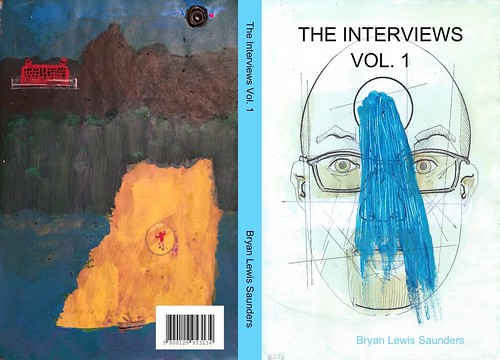
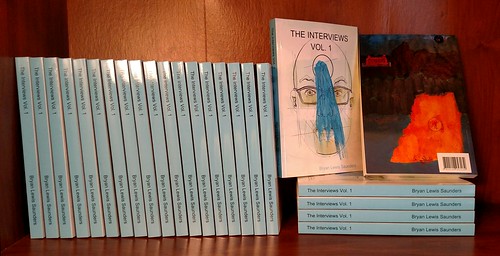
"THE INTERVIEWS Vol. 1"
(58 Interviews, 268 Pg., Unedited)
ATTENTION:
Use drop down menu to select shipping options based on your location.

Psychedelische Kunst
Bryan Lewis Saunders – Außergewöhnliche Bilder unter Drogeneinfluss
Schonmal was von Bryan Lewis Saunders gehört? Der 42-jährige Künstler, Kameramann und Poet ist bekannt für seine provokanten und aufwühlenden Vorträge und Aufführungen, die er selber als “stand up tragedy” bezeichnet.
Zudem hat er sich seit 1995 zum Ziel gesetzt, jeden Tag bis an sein Lebensende mindestens ein Portrait von sich selbst zu malen. Mitlerweile befinden sich über 8000 Bilder von sich selbst in seinem Besitz. Er selber sagt, keines dieser Bilder gleicht dem anderen, wie bei einer Schneeflocke oder der DNA. Sorgsam verstaut er seine Werke in Hardcoverbüchern und sammelt sich so kontinuierlich eine beeindruckende Chronik seiner selbst an.
Im Jahr 2001 entschied er sich zu einem außergewöhnlichen Experiment: während einer 11-tägigen Phase führte er sich 18 verschiedene Rauschmittel zu und dokumentierte mithilfe der Selbstportraits die Auswirkungen seiner veränderten Wahrnehmung. Während der Trips oder kurz darauf entstanden diverse Selbstportraits, die eindrucksvoll die Effekte der eigenommenen Drogen und Medikamente wiederspiegeln.
Erstmals 1956 formulierten der britischen Psychiater Humphry Osmond und der Schriftsteller Aldous Huxley (“Schöne neue Welt”) die Wortschöpfung “psychedelisch”, eine neue Art von Drogenwirkung auf die Seele. Daraufhin bedienten sich die Künstler der bildenden Kunst, Film, Musik und Literatur bewusstseinerweiternder Drogen in der Hippieszene der 60er Jahre, häufig in einem Zustand der Trance.
Heutzutage probieren sich Künstler wie Bryan Lewis Saunders in der psychedelischen Kunst. In einem Interview sagte er, dass er sonst eigentlich keine Drogen nimmt und auch nur wenig Medikamente. Zudem leidet er seit Kindertagen unter diversen mentalen Störungen: “I’ve been labeled with: Antisocial Personality Disorder (as a child), Borderline (in my teens), Schizotypal (as a young adult), Paranoid Schizophrenic (at present)…” In einem anderen Interview sagte er:
“Today we live in a narcissistic and obsessive culture, totally overflowing with drugs. And as an artist I am the filter.”
Man mag diesen Menschen für verrückt halten, doch die Bilder sind faszinierend und lassen dem Betrachter unglaublich viel Raum für eigene Interpretationen. Man kann nur erahnen, wie sich Bryan Lewis Saunders auf den verschiedenen Trips gefühlt haben muss, aber seine Portraits geben einen eindrucksvollen Einblick über seine psychische Situation und die veränderte Selbstwahrnehmung.
Weitere Bilder und Informationen gibt es auf Bryan Lewis Saunders’ Internetseite und die VICE führte hier ein interessantes Interview mit dem Künster.
VICELAND TODAY:
"GETTING ABILIFIED WITH BRYAN SAUNDERS" by Benjamin Majoy
Recently there’s been a lot of chatter on the internet about a series of self-portraits that Bryan Lewis Saunders drew/painted/etched while he was on a whole potpourri of different drugs. My friend Kelly sent me the link because the day previous, I sent her a video of some chick on YouTube describing the experience of turkey-bastering DMT up her butthole . That her brain connected Bryan Saunders with that video should give you some idea as to what his work is like.
These portraits alone, though, are hardly interesting enough to merit Bryan any additional attention. It wasn’t until I realized that these 32 paintings comprise only 1/250th of a 16 year self-portrait project that I decided to spend a Sunday afternoon Skyping him at his home in Johnson City, Tennessee. As our conversation teetered between horrifying and hilarious, I realized that–although colossal–the self-portrait project is only a fragment of his dense portfolio of other equally involved multimedia projects. Bryan’s hermitic, Appalachian livelihood fostered an unarguable talent for embarking on extremely bizarre and elaborate artistic undertakings.
What started as a simple conversation about self-portraits spiraled into a cordial chat about crystal meth, Chinese standup comedy, blood, obese girls who suck dicks for attention, the process of getting severely overweight dead people out of an apartment building, and a few other equally engaging topics. By the end of our two-hour chat, I decided that Bryan Lewis Saunders is a living manifestation of Xenia, Ohio in Harmony Korine’s film, Gummo . And now he’s my friend.
Vice: We might as well get this out of the way early, since it’s the whole reason I found out about you in the first place. Tell me about the self-portrait series that you did on drugs.
Bryan Lewis Saunders: Well, I was just living in a big government building with a lot of disabled and sick people and stuff. There were a lot of pills and a lot of people on drugs, and I’ve had a lot of tragic things happen in my life, so…
Like what?
I mean… well, I’ve had a lot of awful things happen to me personally, but at that time I was having a lot of tragic things happen to my friends. One of them died in a house fire, then another one shot himself in the head. The bullet went through one temple and out the other and he survived, but was permanently in a state of confusion. He could only respond if you whispered to him, and he would see leprechauns on your shoulder and would make strange requests about… I don’t want to get into it. Anyways, after I went hiking in the woods for a few months I came back and decided to try this project because I’ve never really been into drugs.
So you don’t usually do a lot of drugs?
No. I have a fragile brain chemistry. I don’t even like to take Aspirin and stuff. So, I thought I was just going to do a different drug everyday and draw my self-portrait since I was drawing myself everyday anyway. I did 18 drugs in 12 days, then my friends got kind of concerned because I was definitely starting to look like I had Down syndrome. First my forehead got bigger, then my face got flatter. By the time I got to the Robutussen (two bottles), you could definitely tell I was starting to get something like Down syndrome.
As awesome as it is that you went to such an extreme to make that series work, I still think it’s kind of dwarfed by the fact that you’ve done at least a self-portrait everyday for the last 16 years. Crystal meth and prescription tranquilizers just don’t compare to the magnitude of that kind of project. How did it originally come about?
Well, when I first started drawing my self-portrait I just wanted to see something different in myself everyday. The artist sees the world, represents it, then puts a part of themselves in the representation. I didn’t want to be like many artists, who seem to only have a very specific style. I felt like that’s not totally real since people change everyday.
And you’ve literally done one of these every day since? I’m sure you’ve run into some boundaries.
Yep. I can do them with my left hand, both feet, mouth, in my sleep, during drunken blackouts, and even with a sharpie sticking out of my asshole. Once I did a whole month completely blind. The only way I can’t do one is if I’m in a coma.
Even though your drug portraits aren’t necessarily my favorite part of your portfolio, I do think it’s indicative of the dedication to extreme weirdness that you seem to give all of your projects. For instance, the one with the bloody feet, Toetem/Totem . What can you tell me about that?
(Laughing ) I was walking by a dumpster on the way to a convenience store and saw all these boxes filled with pictures of messed up feet. Apparently this foot clinic hadn’t been paying their bills, so all of their stuff in storage was being thrown away. I took all the pictures with me and bought these family frames to put them in. You know, those frames with little circles for where mom and dad and the kids are supposed to be? I arranged them like the ingrown family, and the family with extra toes, and people kept coming over to my apartment where I had them all lined up over my couch. Everyone thought they were dead people because they had the person’s name below the toe, and looked like toe tags, so people kept getting really freaked out. And I thought that if it bothered people that much, then I should probably make some sort of totem of it.
OK. What about Fuck Paintings ? What’s that all about?
Oh. I did that in school. The project was called “Get your feet wet.” It was some type of project where you were supposed to just attack the canvas or something. So I had sex with it and took pictures of myself afterwards. The teacher was like “Oh, I really like the way you violated the canvas,” and I just thought it would be neat to take it to the extreme. I don’t know.
In another one of your proposals, there are some pictures of what looks like you sewing your mouth shut. I take it you really did that as well?
Yeah. It was for a photography student’s project. A couple of the photography students were using me as a model, and I had to outdo the other one. Eventually a girl took pictures of me sewing my mouth shut. Then Princess Diana died with the whole paparazzi problem you know, and I thought “Man, I’m going to set my cock on fire.”
Please explain.
I was going to set my cock on fire since the cock can get you in just as much trouble as the mouth, and I was going to invite all my friends and all the school to come and take pictures like the paparazzi. But then when the teacher found about it, she called the ACLU.
That’s too bad. I’m sure that would have been a pretty interesting exhibit. You know, it’s interesting hearing you talk about this, because as much as there is a major shock factor to most of what you do, I wouldn’t really call you any sort of shock artist. It seems like you just think in a really extreme way.
Right. With the standup tragedy, I use shocking images or parts of the story to try and bring people to a certain state of awareness, so that I can just jam ‘em with emotions real hard. Kind of like a certain hypnosis or something. Like if you shock them to the point of being a little numb, you can jam whatever you want in there.
I guess it’s just that you use shock value for a bigger purpose than just to be shocking. Speaking of, how exactly did the standup tragedy stuff come about? It’s an interesting take on performance art, since the whole point seems to be as devastating as possible. It doesn’t really seem like something that people really feel inclined to be a part of.
Well I wanted to be a famous comedian in China. I was living in my aunt’s trailer in Virginia, and the family was having a lot of problems. One of my cousins was on meth. My great aunt had Alzheimer’s. Another one had a stroke. It was a lot of confusion and constant arguing back and forth, so I just thought to myself, “well I’ll be better in China.” I spent like six hours a day, seven days a week for like nine months straight teaching myself Mandarin. I thought that I’d go to some cities in communist China where they don’t have any tourism, and I would do standup comedy there. I figured within one year I’d have my own sitcom, then I’d be doing blockbuster features in China, and then I’d be a big international superstar. I went and did a Chinese wedding in New York City, and it went pretty well, so I went to Fujo to become a superstar. After like the third day, I met a guy who could speak English pretty well, and he told me that they didn’t have stand up comedy in China. I was pretty devastated, so when I was forced to leave I thought, “Well hell, Tennessee is pretty cheap, so I moved back here and decided that I’d just do standup tragedy and try to make all of these strangers cry instead.
How does that work? I guess there are a lot of ways to make people cry.
One of the first ones I did was about overweight girls sucking dicks to be accepted.
Yeah, that’s a pretty heavy topic. Is there a specific reason why that was the one you started with?
Well, I’m not obese myself, but uh… I don’t know. Growing up in northern Virginia, there was a girl who was overweight. She didn’t want to eat anymore because she was so upset, but the doctor’s said they wouldn’t wire her jaw shut if it wasn’t broken, so one Friday night, after everyone had just gotten out of the Rocky Horror Picture Show , we all went to Dunkin Donuts and she signed the back of a take out menu that said “I’ll give anyone 35 dollars and permission to break my jaw.” You wouldn’t believe how many people lined up out back behind that Dunkin Donuts trying to break her jaw. Then there was this one guy who called himself Psycho who went and got a baseball bat, and I just left. I don’t know what happened. I never saw that girl again. Never knew if her jaw got broken or anything.
Holy shit.
I have a CD called Busting Open because in my building, when someone dies, if someone doesn’t find them right away their body kind of busts open. With these people that are morbidly obese, when they aren’t found the maintenance guys call it “busting open big time.” Their abdomen ruptures with a wet pop and it’s just nasty. In my building, there are people who are so obese that they can’t even leave. When they die of their obesity, the fire department has to come with an electric saw and remove an arm or a leg or something just to get them out the door. See, most people who live in big cities have no idea about this stuff that goes on in small-town America or whatever. With the standup tragedy stuff, people just need to know. There may be reality shows about obesity and whatnot, but you don’t get to really hear what’s really going on.
You sound kind of unfazed when you’re talking about people dying in your building. Does that kind of thing happen often?
Yeah. It’s a bit scary. My friends don’t like me living here, but I think it’s kind of exciting. I found a bloodbath in the stairwell one time and took some digital pictures of it. It looked just like an art installation, like someone was trying to create a bloodbath. It was like life imitating art; the most beautiful bloodbath you could ever find in your life.
Gross. So the last thing worth mentioning, because it seems to be the project that occupies most of your time these days, is the Sleepworks . I suppose on a surface level, it just looks like audio recordings of you talking in your sleep, but I’m sure there’s much more to it.
Yes. Well, I’m really tortured in my sleep. I would have terrible dreams but I would wake up and not remember them. So in the morning, I would try to write them down in a dream journal, but by the time I would start writing, I would forget like half of what happened. So one day, I had the idea that I would sleep with the tape recorder. After time, I classically conditioned myself to push the record button in my sleep.
I randomly downloaded one of them to try and make sense of the project. I think it’s called “Le Bobcat”? What exactly is going on there?
I had this dream about a bobcat that came over to our house and was interacting with us. Then it had to go to the doctor because it thought it was pregnant, and it scratched me real good on the back of the leg and I was like “I think bobcats are cute and everything, but if one attacks me I will cut it up.” Then over time, the bobcat turns into this woman, and we’re dating, and then it gets really bizarre. There’s these recordings that strangely happened the same night that say “These forward and backwards revelations are going to breath and bring the spirit world with the real world, because hierarchy’s important with them.” So what I did was take what I said, and make it forwards in one ear and backwards in the other. Then I took the sound of real bobcats in heat, then in stress, then purring, and I played them backwards. The idea was to have the listener listen to this tape on repeat with headphones while falling asleep so that the bobcat dream would enter into the dream of the listener, even though the listener is a different person with their own brain and experiences and neurons that make up whatever they’re going to dream about. Their dream would be the final work of art.
I tried to figure out if the people who bought the album listened to it when they went to sleep and if the bobcat entered their dreams, but they were all like, “Man, that was a nightmare! I’m not going to listen to that when I’m going to sleep!”
BENJAMIN MAJOY
"Bryan Lewis Saunders' Strange Experiment"
February 4, 2011 1:55 PM
The Sputnik - Scott Blacklock
“I started it in 2001 and I probably did… Well, I could count,” says Bryan. He begins vigorously flipping through a black leather-bound book, counting under his breath, his lazy, twangy Southern accent clinging to every word like thick, sticky syrup. “14, 15, 16… I did 18 of them in, well, let me see how many days. How many did I say? 18?”
“Yeah,” I answer. Bryan searches through his book again and whisper to himself.
“10, 11… 18 of them in 11 days, from the 2nd to the 13th of August.” He looks up into his webcam’s lens, grinning proudly at me. It was sort of a weird moment: there was Bryan, thick-framed glasses resting high on the bridge of his nose, black toque pulled tight over the top of his head and wearing a bunched-up, safety vest orange-coloured hoodie, looking at me, the bewildered but poker-faced interviewer, like a grinning kid hoping his father was impressed after that massive cannonball off the diving board.
I didn’t say anything in response – I just flashed an acknowledging smile and a nod into my webcam. We were about 1,300 miles apart and had only been talking for 23 minutes, but I already knew that Bryan Lewis Saunders, the 42-year old Tennessee-based artist whose work I had stumbled onto recently, was a talker – an interviewer’s simultaneous dream and nightmare. He started up again a moment later. I wasn’t shocked.
“I have a real fragile brain chemistry,” came his unsolicited follow-up. “I’m really sensitive to things. I don’t hardly take an Aspirin for headaches. I’m real paranoid about different types of medication, so I always try to be careful with my brain chemistry.”
He pauses. I could tell he had more to say, so I listened. Finally, he said, with a thoughtful smile:
“It’s interesting how a drug will change you.”
I recently found a link to a page from Bryan’s website. It was titled “DRUGS.” I proceeded to spend 20 minutes gawking as I scrolled down the long page of self-portraits.
See, the Drugs self-portraits – just one collection in Bryan’s multiple series of autobiographical drawings, is a bit of an experiment. His hypothesis: by taking a massive variety of drugs and drawing himself while under their influence, Bryan thinks he can better explore this world of experience. So, ever the diligent socio-emotional scientist, in August of 2001, Bryan tested his hypothesis by consuming a cornucopia of opiates, hallucinogens, uppers and downers, as well as some more “out-of-the-box” substances like cough syrup and lighter fluid.
Eighteen drugs in 11 days.
“I overdid it,” he says with an excited giggle. “I got too excited because the drawings were so unique and interesting.”
Bryan overdid it so badly that after his initial 11-day binge, he suffered from what he calls “temporary brain damage.”
“I did 18 drugs in 11 days,” he says, “and sometimes more than one drug in a day. Some drugs you’re not supposed to mix, so it just kind of ruined my brain for awhile there.”
I’m staring at Bryan, amazed by how casually he describes those surely scary days of lethargy and aftershocks. I ask him if he ever worried, before he began the experiment, of enduring damage with some sort of permanence.
“The pictures online, I think they’re in alphabetical order now,” Bryan says, “but if they were in the order of how they were done, you could see an evolution for sure of the damage being done to my brain.”
The self-portraits in the Drugs series range from the jubilantly coloured and peaceful (Abilify/Xanax/Ativan, marijuana) to the quirky and odd (Adderall, psilocybin mushrooms) to the disturbing (PCP, cocaine). And in that last category is a self-portrait guided by a substance that Bryan admits to have been terrifyingly uncomfortable.
“I tell you, that Seroquel, that anti-psychoactive agent,” he says, trailing off and pausing for a second. “That thing, boy, that was scary.”
Quetiapine, marketed as Seroquel, is an antipsychotic drug used typically in the treatment of schizophrenia, acute episodes of bipolar disorder and other serious mental illnesses.
The self-portrait Bryan scrawled in pencil while under Seroquel’s influence, dark, scratchy and comprised largely of sharply angled shapes, is starkly contrasted to many of his other portraits. It betrays a frightening experience.
“I’ll sit in front of [a mirror] with all my supplies laid out and then I’ll take a drug,” he explains. “Usually takes awhile to work, so I’ll start drawing my proportions, like just getting the basic framework in and while I’m doing that, I’ll start feeling it. Everything will start changing.”
“But with the Seroquel, I was looking in the mirror and all of the sudden,” he says, beginning to motion with his hands above his head, “this big, dark, black mass of weight just kind of settled down upon me and this inner voice said, ‘don’t look in the mirror.’”
“So I look at the paper and I started scratching on it, trying to avoid the mirror in front of me. And then all of a sudden, that black thing went ‘JJJUUUUGGGHHH!” – sort of like electricity, and it goes, ‘Don’t look at the paper.’ And I barely had time to look over at the bed and think, ‘whoa, I might need to lie down’ and as soon as my head turns, it goes – ‘DON’T LOOK AT YOUR BED!’”
Bryan says it took every ounce of willpower to fight against this commanding voice in his head and continue drawing. “It was like my brain was being separated,” he explains. “It cuts your brain off from your bodily actions. It was a real hard battle.”
That was nearly a decade ago – those intensely dangerous and euphoric 11 days in which Bryan consumed 18 different drugs. Today, he’s still committed to his experiment, though in greatly reduced intensity. He’ll only draw another drug-influenced self-portrait when his the timing is right or, as he says, when his “brain chemistry is perfect.” For Bryan, this experiment, among the many that he has constantly on the go, must to continue; it’s not just a hobby for him, but a way of living passionately and significantly.
“It’s not about trying to get obliterated,” he says. “It’s about trying to get this nice collection of my feelings on paper. The drugs are just one small part of the whole entire body of work… It’s not about getting completely wasted – it’s about trying to feel as many different things as possible while I’m still alive.”
At the top of the web page at bryanlewissaunders.org marked “DRUGS” is a link – “Click me for the full story.” If you follow the instructions, you’re taken to a blog post (link at the end of this article) titled “Bryan Lewis Saunders is Chasing the American Dream (By Taking a Lot of Drugs).” A catchy Hunter S. Thompson-esque line, but I think that’s too simple. It paints Bryan as this intrepid, staunchly Western explorer, but that’s not at all who he is.
I realize something about Bryan as I sit there, listening to him tell a 12-minute story about how he learned Mandarin in 9 months so he could travel to China to be a stand-up comedian. I realize that it isn’t the American dream, whatever the hell that is, that Bryan is chasing; that has something to do with capitalism, money and Willy Loman, if my memory serves me. In his pursuit of new and unique feelings at the cost of anything, even his health and sanity, Bryan Lewis Saunders is chasing a dream all too familiar to those of us still alive enough to feel the blood of life course through our veins – the human experience.
Bryan Lewis Saunders is Chasing the American Dream (By Taking a Lot of Drugs)
Jan. 17th, 2011
Dinosaurcity.org
( Drawn under 4mg. of Dilaudid )
" ...today we live in a narcissistic and obsessive culture, totally overflowing with drugs. And as an artist I am the filter... "
Bryan Lewis Saunders is an artist without any doubt --- when he creates things, people break down and cry. In short, he is a great leader of catharsis and true emotional expression in a modern world of nervous silence.
Although Saunders is renowned mostly for his spoken word poetry, he has earned himself a fair deal of notoriety with one specific project of his - testing and artistically showing the effects of various illicit substances. Each day, through a series of self portraits, Bryan Lewis Saunders opens a new chemical doorway - and sketches his visions and experiences of the unknown pleasures that lie waiting beyond.
dinosaurcity had the chance to sit down with Bryan Lewis Saunders and discuss his personal tribulations with this project. This is the transcript:
How old are you?
BLS: Almost 42.
Where are you from?
BLS: I was born in Washington D.C. but I've lived in Tennessee off and on for so long that I tell people that I'm from there.
What led to the decision to start these self-portraits under the influence of various drugs?
BLS: Well I've drawn/painted at least one self portrait every day since March 30th of 1995 and on some days I experiment with drugs. However, the drug series itself began in 2000 when I moved into an 11 story building with the idea that I would make a documentary on all of the interesting characters there. The building, is well known in Johnson City for its creeps and loonies.
After moving in, one of my good friends Jennifer Renfro, from art school purchased an old church nearby and was turning it into a house to live in. While finishing the downstairs flooring she died in her sleep when it caught fire.
The day after her funeral my best friend Don Morgan, also from art school, shot himself in the head, in one temple and out the other with a Russian .32 and survived! Unfortunately he ended up with severe brain damage and permanent confusion. While he was still in the hospital my right lung collapsed for the third time (spontaneous pneumothorax), and I had a lobectomy in which they removed the top half of my lung to prevent it from collapsing again.
Meanwhile my other best friend, Brandon Bragg, was on the Appalachian Trail Thru-Hiking from GA to ME. experiencing great and wonderful things in nature. Once I myself got out of the hospital and Don was sent to a nursing home, Brandon was hiking in nearby Damascus, VA and convinced me to continue the journey with him. I had never been hiking before and with only 1 1/2 lungs I put my life in his hands.
It was incredible. I had 5 pounds of art supplies with me! Every day I saw tons of beautiful things in nature. I'm from the city and so every new kind of bark I saw, or toadstool, or wild animal gave me such a rich wealth of phenomenon to draw and see myself in a totally different world. That experience was truly miraculous and healing. (To this day that book is my favorite of all of the self-portrait books.)
( Huffing Lighter Fluid )
Anyway, back to the drugs.
While Brandon and I were hiking one day he asked me, "Whatever happened with that documentary you were going to make with the veterans and the loonies?"
And I told him how everything had happened so fast with the tragedies and how I thought the people would be really interesting to document, but in fact they were all on drugs, suffering in solitude, some too obese to physically leave their apartment, and for many it was all they could do to get out of their recliners 3 times a day. And I told him how when I first moved in, a paraplegic in a wheelchair showed me an encyclopedia of pills and said he could find at least one of every kind of pill in that book in the building and that book was huge!
When Brandon and I got to NY, I unknowingly became very dehydrated and started hallucinating and had a psychotic break and ditched him at a monastery because I thought he was trying to poison me. I took the greyhound straight back to Tennessee where I had an epiphany. I thought not only am I going to draw myself everyday, I'm going to do a different drug everyday, after all there was one of everything in the building...
And that was when I officially started the project.
What were your favorite substances consumed? What were the worst?
BLS: Xanax (totem poles - 4mg) would probably be one of my favorites. It made me feel real at peace with life and with the trauma, and it also made me a real social dynamo! I'm sort of a recluse but with the Xanax I could just walk up and talk to total strangers! The Butane Honey Oil was a real blast too!
The worst is a toss up between PCP and Seroquel (heavy tranquilizer/anti-psychotic agent) 100 mg. I went to a doctor to hopefully get more different drugs and told him about my project and showed him my pictures on various drugs and he only wrote one prescription for 90 Seroquels thinking I was psychotic for taking such an undertaking and it was awful!
I always saw the lion in Africa on TV with the hurt foot getting shot with a tranquilizer dart and assumed that that lion was woozy and in lala land! Boy was I wrong. In reality, that lion actually wants to tear out those people's throats with awe inspiring savagery but it just can't move. At least that is how the Seroquel did me. It's a long story but as you can see from the drawing I had to fight against its effects, and it took every ounce of strength I had!
( Ladies and gentlemen, PCP! )
The PCP was just as bad. Any drugs that detach your mind from your body I don't care for too much. The PCP day I ate a ham sandwich with tomatoes in it and people kept knocking on my door asking if they could look at my Appalachian Trail self-portraits and I'd get to telling about 20 people at a time all of my hiking stories and showing them all of my drawings and then all of sudden someone would whisper, "Bryan, these people aren't real." And I would flip the hell out! Because even the person that whispered that wasn't real. And then there would be another knock at the door and more people would come in wanting to see my pictures and they too weren't real.
What's crazy is, my friend Audra said that she really did knock on my door and could hear me talking in there but I wouldn't answer it. It was all I could do to draw myself vomiting on PCP, and each time I heaved my face shifted off in stages and red clumpy chunky stuff kept coming out of my nose. I thought my brain was hemorrhaging, but it turned out it was just tomato from my sandwich. Thankfully.
Before the self-portraits, how experienced were you with these substances? Were there any you did the first time with these experiments?
BLS: I've always experimented with drugs to some extent, and when I was much younger I had a couple of seizures on cocaine binges, but many of them were new to me. Most of the pills were new and some of the huffing.
People that don't 'really' know me often think I'm a party animal because of this body of work, but in truth I will only do a drug for the drawing/experience and if I've never done it before. Some drugs I have already done, but it was before I began drawing myself every day so I'll do it again under the influence.
( 2mg. of Xanax )
I've snorted Heroin several times, but I've never done a drawing on Heroin because I haven't had the opportunity since I started the project. I only do drugs that people donate to the project. All all that I really care about is how drugs change my perception of the self. As the scientist and the 'lab rat' I often have to wait to be in the perfect place in life and in the perfect frame of mind and in the right environment with the right people or alone which can take months sometimes to get all of that aligned. I do this to drastically limit possible outside factors that may complicate the self-perception.
From an artist's perspective, what drugs have been the most useful for you?
BLS: I would say none of them were very 'useful' outside of just sharing a one time unique experience. Adderall did seem to give me a lot of patience and focus, but I wouldn't say it was more useful than Salvia which I started drawing right before taking and finished by painting right after.
Even I, who has conditioned myself to draw while in a drunken blackout and not remember it, still can't draw when completely obliterated or on a different planet, so I try not to overdo it. The act of drawing is much more useful than any drug.
( The artist, having snorted a 10mg. Lortab )
On your website, you mention that you became "lethargic and suffered mild brain damage" because of this experiment - can you elaborate on the after effects?
BLS: Well, in the beginning I got carried away and became enamored with the uniqueness of how the different drugs made me see myself and how each one had its own special quality. And after a few days or so the excitement was really building up in me, As to were the different drugs. And as soon as the effects of one would wear off I'd just do another one without thinking about any harm I was causing myself.
And then when the word got out about the project people started really showing up at my door with all kinds of stuff, I mean really cleaning out their medicine cabinets for me. So the day after someone showed up with 2 bottles of Robotussin and a can of lighter fluid.
My friend Audra saw my pictures and the breaking down of my mental state and said, "Look! Bryan! You're giving yourself Down Syndrome!" (to put it nicely). And sure enough I had been mixing the wrong drugs with each other for days and gave my self mild-brain damage without even knowing it. Luckily not permanent and thankfully she was there to even spot it. It was quite some time before I tried a new drug again.
( The onset of two Psilocybin Mushroom caps )
Are these experiments still going?
BLS: Yep, the drawing still goes on. Never missing a day. Just finishing up my 89th book of self-portraits and quickly approaching 8,000 in all.
Not all of them on drugs of course, but from time to time when the situation presents itself and an interested party donates a new one I'll do it. But only on my own terms, like I said everything has to be just right I only do it for the drawing.
What's next? Where's the acid?
BLS: As far as acid goes, I've tried acid 3 times in NE Tennessee and all 3 times it was really crappy. Nothing like the U.V.A. acid in the mid eighties. People here say, "I did 8 of 'em. I took 4. I did 6 of 'em.". And I'm like, "If one doesn't do it for you, why take 7 more? That's ignorant!"
As for what's next, it all depends on what people give me. I don't seek them out and there are still plenty of big ones I need to draw under the influence of; Heroin, LSD, DMT, Computer Duster, Ayahuasca, Peyote and I don't want to die until I do a self-portrait on Crack. You see today we live in a narcissistic and obsessive culture, totally overflowing with drugs. And as an artist I am the filter. Picasso and Matisse got it right when one of them said, "Cézanne is the father of us all." It's not a stretch by any means to say, "On some days, my brain chemistry is my vantage point and my face is his Mont Sainte-Victoire."
( The artist, having snorted 15mg of Buspar )
For people interested in this particular body of work, my Facebook has the best and most up to date collection of drawings under the influence. And I'm a weird person, and I'm way more well known for other stuff besides the drawings and drugs...


